Growing Old with Boots the Dog

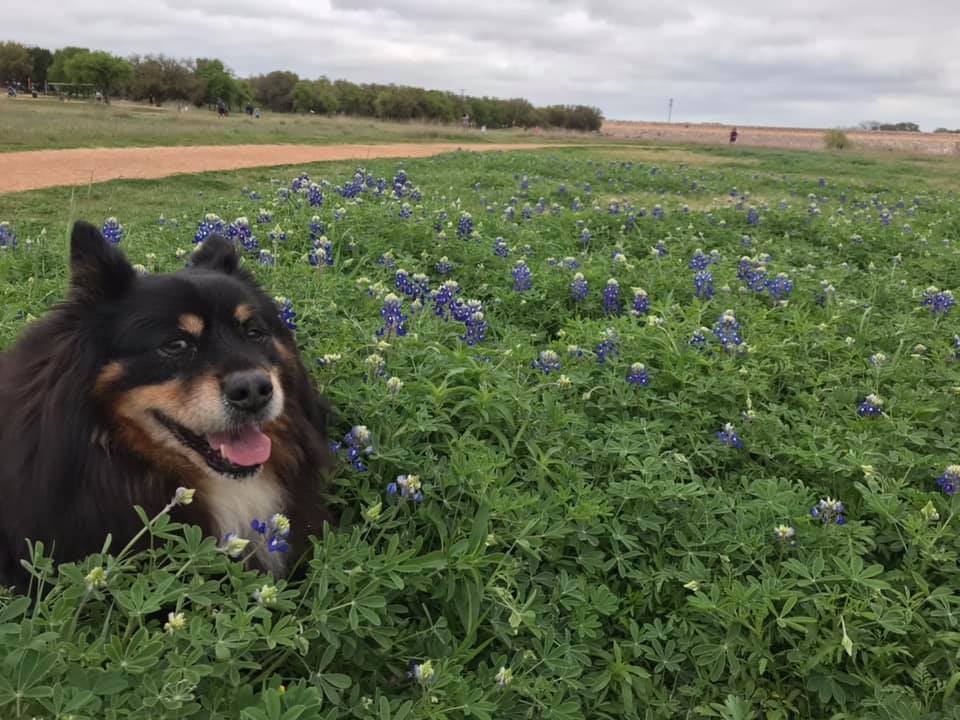
FeaturedBoots the Dog In Bluebonnets

He is old now but once he was young,
Our Bernese-Chow Boots with the big red tongue,
We got him the day when I was really sick,
So, my wife and daughter said we better get him quick,
Because Dad won’t notice while he is asleep,
We can bring him in the back while he is snoring deep.

Later that day from my slumber I awoke,
And from surprise and pneumonia, I thought I’d choke.
I said what’s this dog that looks like a bear,
And when he sheds, you’ll need to clean up his hair.

But Kendall begged to keep our dog-bear Boots.
“I need a friend since Kyle is leaving, and isn’t he cute?”
I said OK, but keep him out of my way,
Because at that time I was all work, and no play.

But later I found that Boots was just like me,
We both loved my wife and the family,
And I was overweight and looked a bit like a bear,
We both had heart problems, so we had to take care.

My wife took us for walks, last chance workouts, we called it,
Because both Boots and I had to get fit.
And as we trained and struggled, we both got better,
Boots in his long hair and I in my sweater,
And I came to love that dog who was just like me,
Who loved nature, birds, and especially trees!

The years grew long and both of us got old,
Our joints got creaky, and our noses cold,
But Boots had one last lesson to teach,
One of patience and love, that we often preach –
But Seldom Do.

For you see Boots is now older than 102,
But his love is pure, and his heart is true,
He circles the house to grasp one more day,
And sometimes barks, when it is not OK.

But I have grown to love him and feel blessed,
To have one more day to clean up his mess,
With our dog Boots, who is just like me,
A cherished member of our family.

Don Grier
Boots the Dog In Bluebonnets
Boots loves nature, birds, and especially trees!

The Master Upstairs

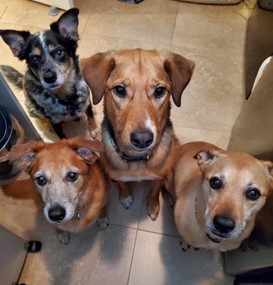
FeaturedDogs looking for there Master

I wrote this poem upon my brother’s passing. May it bring comfort as we remember all the saints and souls who have gone before us.

The poem tells the story of what the dogs my Brother David and his wife owned were thinking about in his absence.

Dogs Looking For their Master
Where is my Master?
Zooey looked at Sis,
in that mischievous way,
Where is our Master?
I want to go out and play.

Our yips are a little less yippee,
Our yaps a little less yappy,
What happened to our Master,
Who always made us happy.

He gave us kisses and never fleas.
He let us do our business on his trees.
What happened to him? Where did he go?
And what happened to our Mom,
She is moving rather slow.

Alvin pawed at Jasmine ,
And echoed what Zooey said.
Where is our Master?
who always patted our head.

He gave us snacks,
And it was always a treat,
When he let us wrestle,
At the boots on his feet.

Where is he Jasmine?
Where is he now?
We got to help Mom,
And find him somehow.

Then Sis looked at her siblings,
And said with a sisterly grin.
You can’t look for him outside,
You have to look within.

For like our brother Ranger,
He went to his Master above.
Who entered the world one December,
And showered it with love.

And he waits for us in Heaven,
Again, leading the way.
Where there will be no more sorrow,
And all good dogs get to stay.

Then all four dogs were silent,
As they turned inward and prayed,
And in their souls they saw our Master,
And again with their Dad David,


They yipped and yapped and played!

Exploring Christian Sonnet Poetry: Discernment

Featured

I am working on writing Christian poetry in sonnet form. While I am not William Shakespeare or Malcolm Guite, the form is good practice. Here is a Sonnet I wrote after facilitating a LifeTeen class on discernment.

Discernment

We wander while we wait for a pathway,
To guide us on and make directions clear.
A mission true, from which we will not stray,
A purpose strong, a goal to hold most dear.
But life obscures the place and final plan,
That makes our hearts leap high, and souls rejoice.
We struggle onward, lost in the hinterland,
Until we stop to hear God’s quiet voice.
Not shouts nor cries, but whispers in the night,
Instructing us with wisdom from above.
A path revealed, aglow in gentle light,
To lead us forth with purpose and with love.
So listen close, in stillness, let fears wane,
And follow where He guides, the path made plain.

Navigating Life Between Epiphanies

Featured

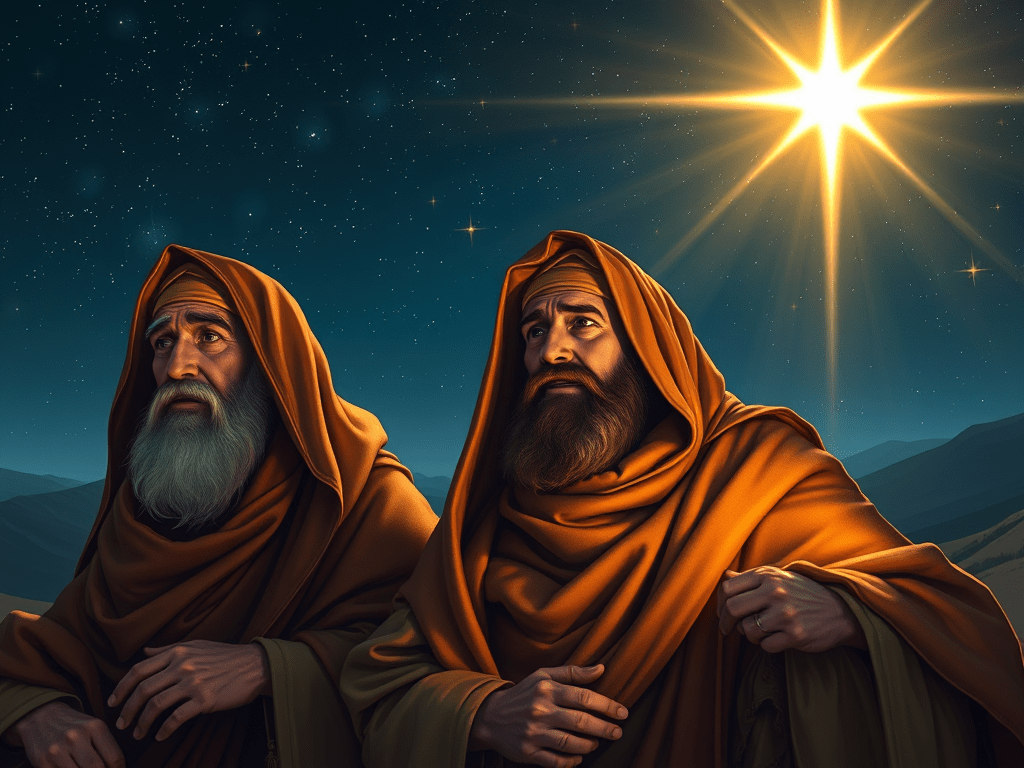
Last Sunday was the feast of the Epiphany, the typical ending of the Christmas season. In this context, the Epiphany is defined as the manifestation of Christ to the Gentiles represented by the Maji (the Three Kings).  I wonder what the Maji felt as they returned to their homeland and got further and further away from the Christ child and the Star of Bethlehem. Did they feel sorrow and sadness, or did the knowledge of the epiphany spur them to greater spiritual heights?

The epiphany
We Live Life Between Epiphanies

Epiphany has a second definition in the secular sense. It means a sudden revelation or insight. For example, you can imagine Thomas Edison saying, “I had an epiphany after inventing the first light bulb,” or Alexander Graham Bell’s excitement when he first heard the voice over the telephone. It is easy to be motivated while you’re having an epiphany or leading up to a new insight. But most of our lives happen in between epiphanies. What you do in between inspirations leads to a meaningful life.

Today’s blog is all about what we do in between epiphanies. How do we discern and discover our next great insight? What are the steps that we follow to reach that next epiphany? How do we remain hopeful and motivated in between the high points?  Most importantly, how do we prepare for the final epiphany that occurs only in our passing? You can read related blogs here and here.

Searching for Your Next Epiphany

The wise men did not go blindly in search of the prophesized King. Instead, they read the charts to find the Star of Bethlehem, their North Star that led to the Epiphany. Similarly, ship captains look for the North Star to orient them North correctly. 

Finding your next North Star is equally vital as you navigate life’s trials. The best way to determine where to go next is by reflecting on your last peak experience.  What about your previous highlight made you fulfilled and on the right track?  How do you build on that insight to raise yourself to a higher level?

Here is an example.  In 2015, I had a clear North Star.  I had to lose weight and get healthy to support my family and team.  I reached my goal of losing 150 pounds, which was both exhilarating and worrisome.  After achieving the goal, I could have had a letdown after the initial high. 

Instead, I decided to build on what I had learned and pay it forward to others.  Also, I understood that although I had improved my body, my soul still needed work.  So, I made a goal to apply the lessons I learned in meeting my health targets to improve my soul.  I established targets for prayer and ways to display kindness to others. 

Once you have determined your North Star, you need to envision it.  Develop a Vision Board, a series of pictures and text describing where you are going next, and keep it where you can see it daily.

Following Your New North Star

Identifying your purpose and next peak is step one.  Now, you need to make a plan to reach it.  Think of all the planning the wise men had to do to get to Bethlehem.  They had to secure Camels, provisions, and equipment for the long journey.  They also had to adjust to the sandstorms that knocked them off their path.

You need to practice similar intentionality, planning, and adjustment.   Establish interim SMART goals to guide you on your journey.  SMART stands for Specific, Measurable, Achievable, Relevant, and Time-Bound.  Do not wander lost in the desert of irrelevance buffeted by the sands of discontent. Instead, like the wise men, they plan to reach the Epiphany at the appointed time.  And do not get knocked off-track by the occasional sandstorm.

Living the Mountain Top Moment

When you reach a high point, relish it. Live in the moment and learn from it to carry on during the low periods. 

Again, take the example of the Three Kings. They took the time to pay homage to Jesus and presented gifts of honor and thankfulness. They also used their experience to change their lives. The Bible records that they returned to their land by a different path, avoiding Herod. Also, the Epiphany and its memory sustained them on their long journey home. 

It also changed their direction in life.  After the Nativity visit, the three kings lived a virtuous life.  Legend has it that they were instructed and baptized by St. Thomas the Apostle in his travels to the East.

The Magi’s experience after the Epiphany has important lessons for us as we savor a high point and then return to everyday life.  First, celebrate your achievement and take time before moving on to the next thing.  Second, distill the lessons learned from your peak and use them as fuel for the road.  Lastly, when you hit a roadblock to your next destination, recall your Epiphany to provide hope and faith.

The Last Epiphany

As we travel our earthly road, one thing should guide our direction while we live between Epiphanies—the last revelation.  The life we have lived and the kindnesses we have shown will be measured when we see God face to face.  This final road may be long and hard for our bodies, but our souls can strengthen until we reach the everlasting Epiphany.

Celebrating Christmas – Faith and Togetherness in Crosswicks

FeaturedCrosswicks Sign

Christmas is meant for community. Each year, the light that comes into the world brings us together. This joy is to be shared among friends, family, and neighbors!   

I remember sharing this joy and love in my hometown of Crosswicks, NJ.  Here is a picture of Main Street blanketed in snow.  It got me dreaming of Christmas in Crosswicks.

Snow covered street in Crosswicks during Christmas

Picture of Main Street Crosswick by Katherine Caldwell

I am never tired of thinking of Christmas in my hometown.   The snow glistens in the trees.  The 100+ year old Christmas tree bursting into light!  Neighbors singing Christmas Carols around a bonfire and later warming themselves with hot apple cider.  The candlelight service in the 200-year-old Quaker Meeting House.    There are four main reasons Christmas in Crosswicks is unique and makes the holiday shine brighter.   

Christmas in Crosswicks is Historic

Crosswicks was settled by Quaker immigrants in 1677, and  Christmas celebrations and worship have been ongoing ever since. The Quaker Meeting House, which still stands and holds the annual Candlelight service each Christmas, was built in 1773. It even held the ceremony during COVID, except it went virtual, keeping the tradition unbroken. 

The Christmas of 1776 is particularly noteworthy. Colonial troops occupied Crosswicks under General Cadwalader in preparation for the historic Battle of Trenton, one of the turning points of the Revolutionary War.   

Crosswicks celebrated the 105th lighting of the large Christmas tree in the Quaker fields near the Community House.  To see the magic, look at this link for this year’s virtual ceremony. 

One last Christmas moment relates to a historic building three buildings from my home.  Brick’s Mincemeat Factory was built in 1879 and, until 1968, was the state’s largest producer of mincemeat.  It is now a historical building but still holds special memories of the mincemeat pies we had each Christmas.

The historic nature of Christmas in Crosswicks makes it special but not necessarily unique. I encourage everyone to learn more about the history of your town related to Christmas.

Sharing of Faith and Fellowship

Crosswicks had diversity when it came to faith and denomination.  I have already mentioned that Quakers founded the city, and the candlelight service at the Quaker Meeting House is a fixture of the holiday season.  However, one of the things that I remember most about the holiday season is learning about Hanukkah at my elementary school each year.  I still remember the dreidel song taught to us by one of my friend’s mother. Hanukkah was also the Festival of Light, represented by the menorah. 

We also had the United Methodist Church, which my good friend attended. I would sing songs like “Go Tell It on the Mountain” with her father, a retired Methodist minister, that we did not usually sing in my Catholic Church. 

We also had the historic Grace African Methodist Episcopal Church, organized in 1868 and located three buildings down the street from my house. I remember the Christmas hymns of joy echoing forth from the Church. We of Crosswicks were of different faiths and denominations, but we shared our beliefs and joy openly during the season.

Joining in Civil Community 

We also joined each holiday season in the civil community.  Our family joined our fellow “Crosswicksians” each year in the annual bonfire and Christmas Tree lighting.  We would all circle the tree at the Community Center and sing Christmas Carols, both secular and religious.  Voices rose together as one community, and we sang of hope and love! Later, we drank hot apple cider, ate donuts, and shared fellowship about the encroaching holiday season.  To close the day, Santa Claus would ride on the back of the firetruck and toss candy to all of us.  It was all a kid could want!

Exploring the Wonders of Winter with Friends

After all that candy, cider, and donuts, we needed an outlet to burn off the calories.  Our rural town (imagine that in Jersey) offered many options in the winter months. 

No Netflix for us! We grabbed our skates and went skating on the Frog Pond behind the library, or better yet, we sled down “the Hill” behind the old Firehouse. I remember leaving the house at 8 a.m. some days and not returning until 9 p.m. The only breaks were a grape soda and candy at Applegate’s Market. 

We even exercised when getting our Christmas Trees. There was no Papa Noel’s or Walmart for us. We went with our Dad to cut down a tree at Nicholson’s Tree Farm. I am envious of my cousin since she still lives down the street. 

In closing, Christmas in Crosswicks was full of faith, fellowship, and fun.  That is why, some forty years later, I still dream of Christmas in the Crosswicks.  You may be dreaming of Christmas in your hometown.  Christmas in recent years, especially during Covid, feels different from the past.  We may congregate again but sometimes stand apart from our fellow citizens.  And even when in proximity, we sometimes rip each other apart with cutting remarks. 

For some, the light of Christmas may seem a bit dimmer in recent years.  And, despite our best efforts to set our homes alight like the Griswolds, we cannot capture the brightness of a smile or the warmth of a human touch.  Light does not come from a bulb! Instead, it comes from hearts joined by the joy of Christmas! 

Say a prayer for someone in need.  Donate to a charity.  Most of all, we should honor the light that has come into the world with worship and kindness for all.  Until next year, I have been dreaming of Christmas in Crosswicks.  Let me close with a song.  

Christmas in Crosswicks

I am dreaming of Christmas in Crosswicks,
Just like the ones I used to know,
Where people got together,
In all kinds of weather,
To watch the Christmas tree aglow!

I am dreaming of Christmas in Crosswicks,
And the bonfires in the night,
May all your memories be bright,
And when we cross the wicks with neighbors,
we bring more light!

If you enjoyed this blog, you may want to hear it and similar messages in the Change Well Podcast by clicking this link. If you are looking to improve your wellness or your that of your team, check out my other blogs at these two links: https://weightlossleadership.com/ or https://wellnessldr.com/blog/.

The True Meaning of Christmas Eve – Love’s Everlasting Kiss

Featured
Picture of Mount Olivet with Philippians 2:5-11

The True Meaning of Christmas Eve

This Christmas Eve, we wait expectantly for God’s Love Incarnate. Not the gooey-eyed love we experience on a porch swing and a first kiss, but rather the long, hard-fought, victorious love that endures past a last kiss at the cross. The love of a God who so loved the world that he gave his only Son. The Love of our Lord who in the dungeons of Caiaphas, the agony of the Garden, and nailed to the Cross loves us, dies for our sins to be resurrected and gain us a path to Heaven.

The Love of Mary agrees to bring God into this world and stands there at the foot of the cross. She takes that hard-won love with her to the house of John, where she leads the apostles until she is assumed into Heaven and crowned its Queen. The love of a God that endures in the church and the sacrifice of the Saints. Despite our faults and sins, the Love is returning to the Mount of Olives!

This Christmas Eve, we wait expectantly for the incarnation. St. Paul in Philippians 2:5-11 speaks to the emptying of God, which in Greek is called Kenosis. For more insight on Kenosis and poetry on the topic, click this link to read Kenosis by Lucy Shaw with insights from Malcolm Guite.

In closing, the poem I wrote a few years back on the passing of a loved one is appropriate today. My brother went on to the next life today during this last week of Advent. I look forward to meeting again and holding him in my heart.

Love’s Everlasting Kiss by Don Grier

Love does not come easy,
it’s built-in trials,
minute by minute,
day by day.
It is built on sorrow,
As much as hope,
Tears and hardship,
As much as laughter.
It does not flit,
It does not float,
It is SOLID,
and it ENDURES!
Why love then?
It is our purpose and mission,
What we were built for,
What God designed!
Because love does not last,
for a minute or an hour.
It lasts a lifetime,
and through eternity.
So, drive on through the pain,
And strive through the sorrow And with one last kiss,
Reach for the tomorrow.
And, remember in waiting,
Not the words left spoken or tears,
But the smile and loving eyes,
That resound through the years.

My Wandering Path to You

Featured
I am not worthy, but I'll try, 
Moving forward till I die,
Though I misstep along the way,
I get closer day by day,
To life as you meant it to be,
Loving, blessed and Holy,

I don't deserve it, but I'll call,
To catch me when I fall,
To bring me home again,
In your presence, out of Sin,
With a heart meek and true,
In your paradise anew.

Jesus please hear my plea,
Remove the darkness, and let me see,
The path that I should take,
And the one that I should forsake,
On my wandering path to you,
And the mission I'm meant to do.

Copyright Don Grier

Yoked to Jesus: Finding Strength Through Adversity

Featured

Plowing the Hills of Calvaro

Introduction

This a parable story suitable for middle school students and above about the following excerpt from Matthew 11: 28-30.  Questions follow. 

28  “Come to me, all you who labor and are burdened, and I will give you rest.

29   Take my yoke upon you and learn from me, for I am meek and humble of heart; and you will find rest for yourselves.

30  For my yoke is easy, and my burden light.”

Story and questions copyright 2024 Don Grier.

The Yoking

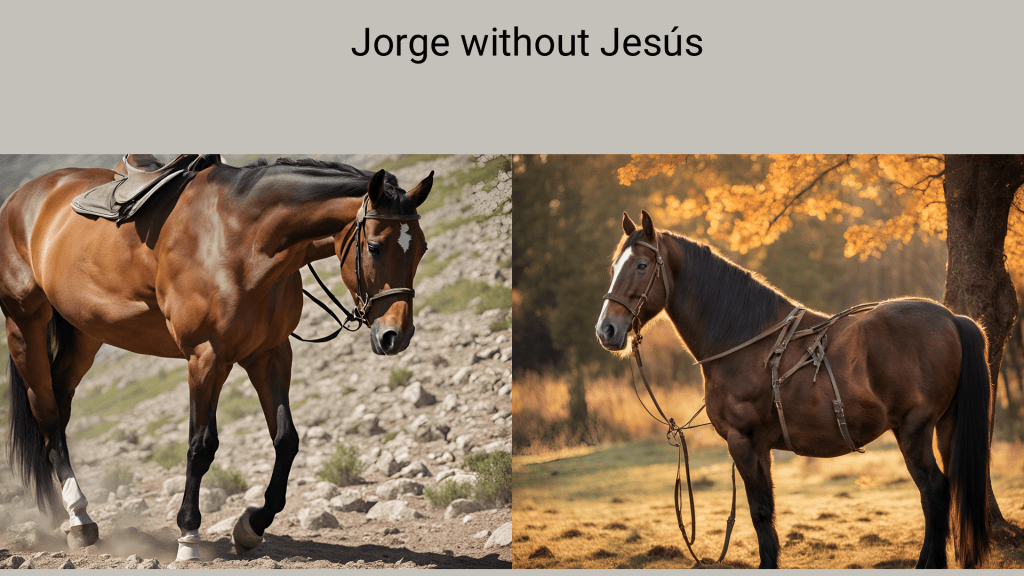
I remember the conversation as clearly as yesterday when I was told that Jesús and I would be harnessed together for the plowing season. 

“I can’t believe Farmer Hector yoked me to old Jesús,” I neighed to my friend Buck.  “What is the Farmer thinking?  Does he want to plow the pasture all Spring? To leave the pasture fallow at harvest time.  I thought he would pick someone young and strong like you, Buck, or Diablo since we would get it done quickly.  What is he thinking?”

Stumble then Learn

But in hindsight, I was wrong! Jesús slowed me down initially when I was galloping too fast.  But I soon realized slower was better in the rocky pasture, where stones can splinter a hoof, as I did one brisk morning when I felt frisky.  But to my surprise, old Jesús pulled us long and more than made up for my injury during the days I was recovering.

After I was healed, I was ready and raring to go. Jesús, let me plod on, seeming to take no interest in our work.   He let me carry a good bit of the load since I had learned my lesson about the rocks and looked to avoid them. It tested my patience and resilience, but I was determined to do my best. 

Jesús’s seeming lack of interest worried me as we approached the Hill of Calvaro.  With the end of spring coming, we had just a few days left to get the plowing done. Farmer Hector loved to terrace the hill because the crops grew better in the cooler climate. 

Climbing the Hill of Calvaro

Jesús again surprised me as he picked up the pace. It took both of us to pull up that devilish hill. I saw Jesús matching my steps and pulling me forward when I faltered. The last drive took all Jesús had, but he did not complain as he lay panting and heaving.  Until, at last, his heart gave out just as we crested the Hill of Cavaro.  Farmer Hector buried him there where he fell, on that hallowed hill.  Jesús died at 33 years, a ripe age for a plow horse.

The Lesson

A few days later (three, I think), Farmer Hector and I stopped at a lake before returning to the homestead. We looked up and were amazed.  In the deep blue sky was one lone cloud shaped like old Jesús.  Farmer Hector said under his breath, “Could it be?”  He just shook his head doubtfully.  But I could have sworn, in the whispering wind, I heard Jesús whinny, “Remember.” 

And I have tried to remember!  I may not be as patient and as strong as old Jesús.  Nor has the harvest from the fields I have plowed ever matched our harvest that Autumn.  But I try as best I can to impart the lessons that I learned while yoked to Jesús.

Questions

1. Think of a time when you did something without Jesus by your side. How did that turn out?

2. Now, how about a time when Jesus carried the load for you?

3. Have you ever thought that Jesus was no longer with you? In hindsight, was that a time for growth?

4. What crosses do you have, and how might walking yoked to Jesus help you?

Boost Your Wellness with Body and Soul Habit Stacking

Featured

This second two-part blog series focuses on practices that nurture the body and soul.  The first blog of the series, Good for the Body, Good for the Soul, covered five powerful practices that can help you promote your soul and, in turn, improve your health and disposition.   This blog will cover how to stack in sequence or, better yet,  run body and soul habit combinations in parallel for a double whammy. You can also hear both blogs with additional info in podcast form by subscribing to the Change Well podcast, available at our website link here or on Spotify or Apple Podcast.

The concept of habit stacking, as introduced in Atomic Habits, helps to establish beneficial habits more quickly. Here is a simple example. You need to take medication each day, which is an established habit. However, you also want to institute the beneficial habit of drinking sixty-four ounces of water. A way to develop the new habit is to place a water bottle next to your pill container. Presto! Now, you have a ready-made container with the right amount of water next to your pill box. You need to wash down the pills and, in so doing, start drinking the water you need for the day!

I used this habit stacking idea to benefit significantly during my weight loss journey of losing 150+ pounds in under a year.  My physical transformation recovered my body, but my soul was still suffering. I was still sometimes a curmudgeon, and my peace of mind, though better, could still get rattled. So, I decided to piggyback some new soul habits with some of my firmly established body habits.  I will provide examples of my body and soul habit stacks and scrums, more on that term later, that relate to my faith practice – Roman Catholicism.  However, I will try briefly suggesting how these may be adapted based on my research. 

The first stack I tried was what I called the Texas Three Step. I had already established the Texas Two Step method during my weight loss journey. Each Saturday morning, I would get up at 6:00 and work out for an hour and a half before attending my WW meeting. It was good for the body! 

Two years ago, my parish established Saturday morning prayers (called Lauds in the Liturgy of the Hours) combined with Adoration on Saturday in the early morning. This led to my new and improved Texas three-step Saturday ritual. I now get up on Saturday at 5 AM and exercise to get as close to my weight target as possible. I then went to my Church and prayed for an hour to clear the weight off my soul. After praying (and sometimes Mass), I head to my WW meeting to share wellness ideas with my friends, now at the 9:30 WW Meeting. In one fell swoop, I shed weight on body, soul, and shared fellowship to start the weekend right!

I next created a daily body and soul stack.  It was similar to the first stack but less formal without group activities.  I had established an exercise habit that followed my morning water and medication discussed earlier.  I decided to add a prayer meditation after working out and subsequently stretching.  This worked well initially.  I got my heart rate up with exercise, then began slowing it down with stretching, and lastly, I established a contemplative prayer.  The exercise helped my prayer focus, and the prayer helped me slow down and heal my body.  However, I ran into a problem with time management.  I skipped exercises if I had a late night the night before. Or if I thought I had enough but limited time, I rushed both.   I began to put back on some weight because I prioritized the spiritual aspect.  I had to do something to bring them together.  That is when I came up with the idea of body and soul scrums while listening to a book on product management!

Scrum is likely known to rugby fans and software developers but may not be as well known to others.  Scrum in software development focuses, among other things, on parallel activities.  The origin of Scrum as a framework goes back to an article in the Harvard Business Review in 1986. “The New New Product Development Game” by Takeuchi and Nonaka described how first-class products are developed in cross-functional teams with an ‘all-simultaneous approach.’ 

Therefore, a body and soul scrum is when you simultaneously execute body and soul habits.  What is an example? I will use one of the oldest ones, perfect for the beginning of Christian Lent and practiced by many faiths, including Christianity, Islam, Buddhism, Jainism, Hinduism, Judaism, and Taoism – Fasting and prayer!

Intermittent fasting is now all the rage for weight loss. Still, before my Silicon Valley colleagues adapted it to shed pounds, fasting was used by saints and spiritual leaders to deny themselves and develop spiritually.  It is the ultimate body and soul scrum, cleansing the body and healing the soul.  Today, on Ash Wednesday, I fast as part of my religion.  But also practice fasting more regularly to detoxify the body and soul.  I have put a link in the show notes to an article from the NIH on religious fasting

Besides fasting and prayer, I have developed other body and soul habit scrums I use weekly.  They help me manage my time while packing a one-two holistic punch of well-being. 

  1. Mike and Bike. In these previous blogs, I documented my love of cycling on our companion blog site: Peloton Pandemic PandemoniumDon’t Stop Believing: A Weight Loss Journey in Three Intervals. My respect and admiration for Father Mike Schmitz are right up there with this love. He was instrumental in my wellness journey, both body and soul. I started listening to his homilies after a Lenten retreat at our parish and would listen to his homilies while using the elliptical training. With the launch of the Bible in the Year podcast, I have taken it to a new level with Mike and Bike. At least three times weekly, I take a 20-minute scenic ride on the Peloton and turn off the sound. I then turn on the daily Bible in the Year podcast and listen to the Lord’s word while circumventing the pathways of Rome, Paris, or the Alps. With each Mike and Bike, I grow in knowing the Lord’s plan for me and building my quads! You can download the Bible in the Year podcast here Bible in a Year if you want to try it.
  2. Marching with Mary. Last May, I participated in a fundraiser to raise money for the mental wellness of veterans and soldiers. The StopSoldierSuicide.org fundraiser called for me to march 50 miles during May while carrying a 50 lbs. ruck. My 60-year-old body does not march fast with 50 lbs. on my back. It was seriously cutting down on my prayer time. I therefore decided to add reciting a silent Rosary while marching. A rosary is a series of prayers and meditations that use a unique prayer bead called a rosary.   As a Catholic, I believe this prayer practice was passed on to us from Mary through St. Dominic.  Other religious practices have prayer beads to recite prayers, chants, and mantras. This Marching with Mary practice allowed me to add over fifty prayers and meditations on each ruck march. In this way, I was not only able to raise money for Veterans, but I could pray for them, too.
  3. Hinge and Hallow. One of the reasons I ambled while marching was weakness in one of my knees. To help with this issue, I use a physical therapy application called Hinge Health. This application has a set of tailor-made exercises to help strengthen my knee. While doing my Hinge exercises, I listen to the Hallow mindfulness application https://hallow.com/. This application is an excellent resource for all Catholics and includes everything from The Daily Miracle meditation to Gregorian Chants to books from doctors of the Church.  I highly recommend it, and you may have seen their ad at the recent Superbowl, but there are other similar applications, such as Calm, that are secular or of a different faith that others can use. This combination helps me fix my knee and my disposition all at the same time!
  4. Exodus for the soul (and body). The last body/soul scrum is the one that launched it all. Two years ago, I participated with a group of men in my church in Exodus 90. This program is a ninety-day spiritual exercise for men based on three pillars: prayer, asceticism, and fraternity. Part of the ascetic practice is daily rigorous exercise, excluding alcohol and sweets, and days of fasting. It also includes daily prayer practice. It gave me the idea for the other four practices previously stated. I highly recommend it for all Catholic Men who need a wake-up call for both body and soul.

I hope these ideas can help you as they help me improve your body and soul. 

Good for the Soul, Good for the Body – Part 1.

Featured

This is the first of two in a blog series on the importance of mindfulness. You can also hear this blog read and sung on Episode 17 of our Change Well Podcast

There is a definite connection between body and soul.  Be happy, feel better.  Share kindness, win friends, and feel good.  On the other hand, when you are stressed or miss your workout, it is not always easy to turn the other cheek.  Common sense confirms recent studies that caring for others improves the well-being of those you helped and your own!

I have struggled to learn this lesson. I am naturally an intense person and a bit of a curmudgeon—a person who is sometimes not kind to others, particularly myself. Driven to achieve, I occasionally drive other people out and beat myself up. This often leads to regret, guilt, and, more often than not, an eating binge. A happy person is a healthy person, and vice versa.

That is why when I started on my weight loss journey, it was just as important to cleanse my soul as my body.  I took several measures to help me improve my disposition and, correspondingly, my health.  This is what I did. 

  1. Write in my Kindness Journal – I journal six minutes daily in a Kindness Journal.  It sets my daily goals for being a better person and helps me envision the person I want to become.  It also provides me a place to recognize those items the day before for which I was most pleased (being kind to myself) and reflect on those who were kind to me.   Lastly, I set my intention on one kind of beneficial act that I will do to make the world better for others.  I use this particular journal, but you can use another Kindness Journal
  2. Record happy thoughts in HappyFeed – In addition to writing in my Kindness Journal, I record three things I am so glad about each day using the iOS application HappyFeed.  You do not always have to write something earth-shattering.  Sometimes, I write something like, “I got 8 hours of sleep last night!”  The key is to dwell on what makes you happy rather than what makes you stressed.
  3. Pray, Meditate, and Give Thanks – There is no room for worry when thankful.  You feel better about yourself and also those around you.  Also, the Power of Thanksgiving can break through even the darkest hour.  I spoke about this in the following blog.  The Power of Thanksgiving
  4. Help Others – Helping others benefits those you help and others.  First, when you allow others, you focus on them, not the issues you face.  Also, you are so preoccupied with the task at hand, whether it is building a house for Habitat for Humanity or walking to raise funds to combat cancer, that you often do not have time to overeat.
  5. Smile – The simple act of smiling lightens your mood and that of others.  Better yet, laugh; it is the best medicine, as they say.

Working on your heart and soul can make you a better person and help you lose weight – a double whammy (ok enough with the W’s).  I have glorified this concept by establishing my most sacrosanct scheduled time of each day – Body and Soul Time.  If you look at my calendar, you will see 6:00 – 8:00 AM each day, blocked out as Body and Soul time.  This is when I do a weekly set of body and soul combos, combining mindfulness and prayer with exercise—more on next week’s blog.

But for now, let me close with, of all things, the importance of being third. A few weeks back, when thinking about Dr. King’s legacy and other selfless people like Gandhi and Mother Theresa, I tried to find the common thread that pulled them all together.  And I realized it was because they were each Third – behind their religious beliefs and their care for others.  I then thought about how hard it is to be Third in my life and thought of that classic song – “It’s Not Easy Being Green.”  So, I decided to write this song/poem to the tune of It’s Not Easy Being Green.  I hope you enjoy it. My thanks to Kermit!

It’s Not Easy Being Third

It’s not easy being Third,
Putting yourself behind our human family and God’s word,
And people tend to pass you over,
Because you’re not in the latest fashion,
or have cool toys like some other guys.

But Third’s the purpose in your life,
And Third can help end earthly strife,
And Third can change the course of a nation,
Or build bridges to others, or define history.

When Third is what you are meant to be,
It could make you ponder why, but why ponder?
Why ponder, I am Third, it’s written on our Souls,
And it is where we are meant to be.

The Lost Coin: A Lesson in Redemption

Featured

“Or what woman having ten coins* and losing one would not light a lamp and sweep the house, searching carefully until she finds it? Luke 15: 8

Nothing is lost forever,
Where shines the light of God,
For He came to save the lost,
And free those downtrod.

Looking for the sinner,
The lost, broken, and lame,
The rich man and the poor man,
He treated just the same.

A shephard from the heavens,
Not one of his flock is lost,
For He protects and defends us,
Without regard to cost.

And with Word and deed unnumbered,
He swept our sinful souls clean,
Finding the coin of redemption,
Until His time unseen.

We must follow in his footsteps,
Following the lessons that he taught,
Being kind, forgiving and thankful,
Helping those that humanity forgot.

Copyright 2024 Don Grier

A Weave of Life Lessons This Election Day

Featured

Today, I have a lot on my mind. It is the 22nd anniversary of my Dad, Big D, passing, and it is election day.  So, in honor of my Dad, to celebrate our democracy and organize the many thoughts in my head, I will attempt what former President Trump calls the weave.  

My definition of the weave is connecting several lines of disparate thought to develop a consistent theme.   Today’s weave will hopefully create a tapestry of life lessons that lead to wellness.  The thread that ties this weave together is the many lessons I learned from my father and how they have helped me become a better person.  So, let’s start weaving.

Big Russ and Me

I find myself missing Tim Russert this election day. Tim Russert was and still is my favorite journalist. He was the epitome of authenticity and enthusiasm for our democracy. The longtime host of Meet the Press, he was thorough, insightful, and always civil but challenging in his questioning.  I used to watch Meet the Press every Sunday but now seldom watch Sunday news programs.

Another reason I miss Tim Russert is his dedication to family. He wrote one of my favorite memoirs, Big Russ &  Me, about his relationship with his father, Big Russ, and the lessons he learned from him. 

Big Russ and Tim’s relationship reminded me of my one with my Dad, Big D.   The similarities are uncanny. Both raised four children with their wives, did not finish high school, had blue-collar jobs, and served in the military.   Believe it or not, both worked on a Garbage truck.  But most importantly, they both taught life lessons that made their sons better people.

I will not write a book like Tim for this election day weave of lessons (although I could and will someday).  Instead, I will provide the top five lessons I learned from my Dad, resonating even more loudly 22 years after his passing.

Get the Iron Out of the Door.   

What is the iron? Where’s the door?  Iron refers to large turbines that generate electricity in dams.   Big D was a steelworker/machinist, and it was his job to repair the turbines and get them out the door as quickly as possible to their destinations worldwide.  Equally important was ensuring the turbines did not have to come back through the door: this required diligence, consistency, and hard work.    

The lesson is to learn your craft, roll up your sleeves, and work daily at your vocation and for your family.  For more on this lesson and how I applied it to my career in information technology, please read my blog, Getting the Iron Out the Door.

There is Always Room for Improvement. 

My dad was good at getting the iron out the door, but he was always looking for ways to make his team get it done faster, cheaper, and with higher quality. Likewise, he taught us that no matter how well you do, there is always room for improvement. 

He applied this lesson to his personal life.  As mentioned earlier, Big D and Big Russ had not graduated high school.  My dad left school to help his mom and family and entered the Air Force. He got his GED, machinist journeyman certification, and further education in a community college. 

I remember him returning after overtime at DeLaval and practicing the words fuma and puma in Spanish very intently.  Over 50 years later, I can still hear him practicing to better communicate with his fellow union workers. 

One more story about improvement from this lesson.  Improvement does not come quickly.  You must make slow, steady practice.  Big D  demonstrated this aspect by building a lake on his retirement property. 

I remember the first time my Dad started building the lake.  He had just got the backhoe and had begun scraping out a ditch.  He took my brother and me out there.  Then, pointing to a muddy gouge with a few puddles, he said proudly, “Look at my lake!”. 

My brother and I started laughing.  Dad said, “Why are you laughing?”.  My bother pointed out, “Dad, when you say lake, it connotates images of water!  This is not a lake. It is a puddle.”  Dad just shook his head, climbed in his backhoe, and said, “You will see smart alecks.” 

And we saw.  A year or two later, there was a full-fledged lake.  The following year, fish were in the lake and on a dock.  But Dad kept tweaking the lake up to the day he died. 

We wondered why he did this since he proved his point and gave us our initial lesson.   Having returned to the land recently with the direct coordinates in hand,  I found an aerial picture revealing he built the lake in the shape of Texas!  If you want to see the before and after pictures, read our blog, The Return: Have A Vision as Big as Texas.  And always look for ways to improve!

Be Tough, But Have A Heart.   

One area in which my Dad did not need much improvement was toughness. My brother tells a great story about my Dad at one of the campouts that Dad hosted for my brother’s fraternity.  Big D had fallen asleep too close to the fire, and one of his cowboy boots started burning!  The fraternity brothers shook my Dad awake, yelling Big D! Big D! Your boot is on fire.  Big D, not batting an eye, took off the boot, smashed it in the dirt, extinguished the fire, and said, “I am the toughest SOB that ever walked the face of the earth.” 

Big D was tough due to his childhood, but he still had a big heart. He taught us that you must be firm but fair and have a heart for others. I best learned this lesson when I ran away from home. 

When I was 16, I made the rash decision to run away. I was distressed that I was moving away from my home in New Jersey and losing my friends. I thought the world was ending, but really, it was only beginning.

I do not know how he knew where I was going, but my Dad found me. He told me that he was sorry and that I was tough. He then explained that we needed to move to Texas to make a better life. He then hugged me, and I got in the car. There was no yelling. There was only love. 

You can read more about this story and other lessons in the blog: The Lesson Learned When Running Away.

Be Part of the Community.

Another thing that my dad instilled in me was the power of community.  My dad was our Cub Master,  our baseball and basketball coach,  a Union Vice President, a softball player, and a member of several men’s clubs.    He also had diverse friends and included some of our friends in our family. 

I carry with me the importance of community. I am a leader or participant in several civic organizations. The lesson I learned from Big D about community was threefold.

First, he led or was present in our activities to be part of his children’s lives. Second, when you meet people face to face, it is hard to stay in an argument.  You can cast aspersions on someone on Facebook without truly facing them.  It is tough to hold a grudge or an argument when you have to see the person the following week.  Last, when we act in the community, we build others up instead of tearing them down.  We become stronger when we act as a team.

The First and Last Lesson – Be Thankful. 

Big D was always thankful for his community and friends and was unafraid to show it. I will miss the heartfelt prayers of thanks my dad used to say before Thanksgiving dinner. They were simple but profound and gave thanks for all that was given to our family. 

But I will never forget the first Thanksgiving without him and the miracle provided us in his remembrance. I recommend you read the full Thanksgiving Cows blog here, but here is a synopsis and the lesson. 

Two weeks after Big D died, we went to my dad and mom’s ranch one last time for Thanksgiving. The ten cows he was raising were all expecting.

As we rounded the bend, my family saw two new baby calves. During the rest of Thanksgiving, a new calf was born about every hour, so there were nine near dinner time. However, one cow, Rosie, had a problem birthing her calf.  

After much chasing and antics, we finally got Rosie in the truck and took her to the veterinarian.  We did not have Thanksgiving dinner, but I would not have missed the event for the best food in the world.

I had never seen a calf being born; it was a tremendous sight. The vet wrapped a rope around the half-born calf and pulled it. The calf was born after a few moments that seemed like an eternity. After lying on the ground for a few moments, the calf made its first few steps and was alive.

At that moment, despite missing Thanksgiving Dinner, I was never more thankful. I was grateful for my dad’s gift of the cows, and I was thankful for the timing and happiness that the calves’ birth gave me and my family.

Whenever I feel let down or frustrated, I think back to the story of the Thanksgiving calves. And that is a Game Changer. Counting your blessings can change your attitude to one of positivity. It can lift you out of the despair of failure and toward the hope of tomorrow. 

The End of the Weave, Hope for Tomorrow.

We close our weave by coming full circle to tomorrow’s election. Whether your candidate wins or not, let’s remember the lessons of Big D.  Wake up tomorrow to get the iron out the door and food on your family’s plate.  Look for ways to improve yourself and those around you.  Be passionate about your beliefs, but have a heart for those who may differ.  And most of all,  Join in community and be thankful for this great country.  We owe it to the legacy of Big D and Big Russ.

Lost But Found

Featured

We wander our lives,
With purpose unknown,
Our minds half-formed,
Our souls half-grown.

In a foreign place,
That is far from home,
We seek the forgotten,

Untethered, we roam.

God is watching us,
But we refuse to see,
The person and blessing,
We were meant to be.

We seek but are lost,
Oh, the games we play!
Where we’re going, what direction?
Not one of us can say.

So snatch us, Lord,
from the jaws of death,
Give us new life,
Give us new breath.

Help us to seek,
So we can be found,
Our sins all broken,
Our hearts unbound.

And with Your help,
It is not too late,
To find the good,
Forgo the great!

So Stop! Listen!
Forget the strife!
Find your purpose,
Breathe new life,
Find the person,
You were meant to be,
With soul unfettered,
With our spirit freed!

The Way Through The Narrow Gate

Featured

When the young man heard this statement, he went away sad, for he had many possessions. Then Jesus said to his disciples, “Amen, I say to you, it will be hard for one who is rich to enter the kingdom of heaven. Matthew 19: 22-23

As he knelt before Jesus,
He was seeking validation,
That what he was doing,
Met the gist of his oration.

I have kept the Commandments,
Both one and all,
Against sin and temptation,
I did God’s call.

So Jesus, with love.
Looked in the man’s heart,
For eternity’s sake,
Your wealth must part.

For he saw deep,
Into the man’s soul,
That he had forgone wisdom,
And sought after gold.

“Sell all that you have,
And give to the poor,
That is the way,
Through the narrow door.”

But the man’s faith,
Was not strong enough,
“Giving away my security,
Is exceedingly tough”.

So he left Jesus.
And went back to his home.
One of the biggest mansions,
In all of Rome.

The moral of the story,
Is not that wealth is bad,
For work and enterprise,
Was the talent the man had.

Instead, the lesson,
Is closer to this.
Money, wealth, and security,
Don’t equal eternal bliss.

You should use your talent,
For all those around,
And not hoard in fear,
Or let your soul be bound.

Poem – Be Good Not Great

Featured

Be good not great,

For the time is late,

And we have but a day,

To show God’s way!

Seek kindness, not power,

Make Love a tower,

Your heart the leaven,

To seek out heaven.

Take time don’t wait,

For eternity is our fate,

If we do what he asks,

And complete His task.

Seek the Cross not fame,

As your temptations you tame,

For the time is late!,

So be good, not great.

Be Good to Your Family: John Walton

Featured

To date, the series has included only real people with whom I have directly interacted.  In this blog I focus on a person that I have interacted with since the seventies, but only through TV– John, the father on “The Waltons”.

For those not familiar with the series, “The Waltons”   ran for 9 years in the 70’s and early 80’s with specials continuing into the 2000’s.  It covers the trials and tribulations of an extended of family of 11 (John, his family, and John’s parents) living through the depression and World War II in the backwoods of Virginia.    The Waltons make it through those hard years of poverty and personal tragedy with their souls intact largely due to the sacrifices of John and his wife Olivia (who is equally deserving of being the subject of this blog). 

One of my favorite episodes of the series clearly demonstrates John’s focus on being good while foregoing opportunities for wealth and fame.  In the episode, John is uncharacteristically anxious and short with others.  His high school reunion is approaching and one of his fellow classmates want him to organize the reunion.  The classmate came to John because back in high school he and his classmate Grover where always vying for the lead position in the class.  Grover went on to Washington to lead an agency in the Roosevelt administration, while John stayed on Walton’s Mountain eking out a living for his family.  John becomes even more anxious when the person who was supposed to host the reunion cannot and John’s wife Olivia  agrees to host the reunion at the Walton home.

When the seemingly successful guests arrive, they all have problems.  Grover, for instance is having marital problems and his wife does not attend the reunion.  Another one of his classmates, a rich car salesman, has kids who act spoiled and misbehave throughout the reunion.  In contrast, the Walton children are the epitome of hospitality and work together to make the reunion a success. 

The show ends with what I considered the greatest quote from the show and one that highlights the difference between being good not great.  Grover, John’s former high school rival says the following: 

“Six years in grade school, five years in high school-everything I ever ran for, I was always running against the same Johnny Walton… The greatest day of my life was when I beat John Walton out for senior class president. I don’t think he ever lost any sleep over it. Now I’m an ambitious man – some would say successful; probably it’s all John’s fault. I was always running; he was always going past me at a walk. And here it is, 25 years later-here I am, and there’s John. Then look at me… and some of you… still running, still wearing ourselves to a frazzle for all sorts of things that John Walton has accumulated while he was out walking – a happy home, a fine wife and children. We’re sitting here well fed at John’s table, and I’m still boy enough to be graveled at the sight of him. ‘John – the boy most likely to succeed.’ Well, he’s the boy who did.”

This ending always gets me because it shows the choices a parent makes for his family.  There are so many episodes where John demonstrates his love for family over that of money of fame.  Here are three examples:

In one of the later episodes, John demonstrates his ability to organize competing, local sawmills in Virginia to deliver a large order for a rich government contractor.  Noting his ability, the contractor offers John the role of Vice President of lumber operations.  This job holds the promise of wealth, travel and a fine home.  The only issue is John would have to uproot his family.  He declines the role for the lesser opportunity of running a co-op in his hometown for a lot less money and prestige. 

One of the key attributes of a good father is being humble enough to accept the sacrifice of your children.  In another one of my favorite episodes, John and Olivia use all their emergency money to buy their son John-Boy, a new suit for college.  The whole family participates in the joyful event.  John is proud that he can provide clothes for his son to fit in with the wealthier students not on scholarship.  Then the family’s milking cow Chance dies and John is humbled since he does not have the money to replace it.  John Boy takes it upon himself to sell back his suit to pay for a new cow.  This action shows the goodness of his father John in two ways.  First, John-boy is following the example of sacrifice he has seen modeled by his father.  Second, John is humble enough after initial reluctance to accept the money.  John does what needs to be done even though it eats him up inside to provide his son this simple gift.  

In the last example, a developer comes to Walton’s Mountain and notes the beauty of the nature and a hot spring on the mountain.  FDR with his affinity for Hot Springs has raised the demand for these resorts and the developer offers John a lot of money for the mountain and his home.  He at first contemplates selling the land and moving the family but decides against moving the family, especially his parents from the home.  This episode clearly illustrates the sacrifices many sons and daughters make to care for their parents in their older years.  A good father indeed must first be a good son.

I could list at least another 20 episodes of the basic goodness of John Walton and his love for family.  Caring for your family and your spouse is what a marriage is all about!  A good parent thinks of their family first and career second.  Money and fame disappear, but a love of a good parent lives on! So, when facing a decision, let’s be like John and focus on what’s good for the family, rather than what is great for you!

Be A Good Neighbor: TM

Featured

This is the fourth blog of the Be Good, Not Great series.  The initial idea for the blog series came to me in a dream about my Grandpop and resulted in a poem and a blog in less then an hour.  Read it hear. https://weightlossleadership.com/2019/03/16/be-good-not-great/

The series focuses on people that strive for goodness over greatness; who eschew money, wealth and fame to care for other people.

I still remember the first day at the first home my wife and I owned as if it were yesterday.  We moved into an established community in our then sleepy, now rapidly growing town.  The house was 70’s vintage and we were excited but a little daunted. 

We got the home for a good price.  But it did come with some things that we needed to fix.  The most urgent being a large bump in the sidewalk that led to our door.  The bump was due to a tree root that grew under one of the sidewalk panels.  It was a hazard especially for my wife who was pregnant with our second child and our 4-year-old.   I was ready to fulfill my duties as a husband, father and new home owner.

I had managed to lift the sidewalk a bit and was trying my best to cut off a portion with a small axe I had.  I was not making any headway and was sweating buckets.  When out walks a wiry, 60ish year old man with silver hair, from next door.

I stopped my work for a moment and greeted him.  he introduced himself and said, “I am TM your neighbor and son you looked like you could use some help!”  I said, “Hi Tim.  I am doing ok, but it is sure good to meet you”.    Which was wrong on two accounts. 

First because of his Texas twang, I called him Tim instead of TM.  This part was ok because he thought he heard TM due to my Jersey roots. Second, I was not Ok.  I had worked for an hour and made hardly a dent on the root.

After 15 minutes, TM returned with his own axe and said “Don, please let me help you out.  I have been doing this for awhile and we can knock it out together.”  Even though I was embarrassed I relented.  And I was glad I did.  TM immediately made more headway in 10 minutes then I had done in the last hour and a half.  When it was my turn to spell him, he let me use his axe and technique.  We got the root out and sidewalk level in less than 40 minutes together.  It was the start of a great friendship and mentorship.

TM was the perfect example of seeking goodness over greatness.  Born and bred in Leander, he moved to Cedar Park during its infancy to run one of the Cedar Yards for which the city was named. He was a great mentor, devoted husband for 68 years, loving father and a devout church goer.  You can read more about TM here. https://www.dignitymemorial.com/obituaries/austin-tx/thomas-pearson-7060600

There are four lessons from the life of TM to follow as we strive for goodness:

  1. Be a Good Neighbor.  The help with the tree root was just the first example of TM being neighborly. He was always there with a ready hand and a kind smile to help my wife and I with our expanding young family.  With both of us working, we did not always have time to keep the yard up.  When he saw us struggling, TM would take the time to mow the side of our yard closest to him or water some of plants when we did not get to it.  He also helped us with some ideas on landscaping and brought over some vegetables from his garden.  We in return tried to help him out, but never could match his generosity.
  2. Be a Good Family Man. TM was a devoted husband and father.  His only daughter was confined to a wheel chair after she was in an accident.   He and his wife helped care for her.  To make things easier, his daughter and her husband lived with TM.  TM had a specially outfitted van and helped with the medical visits and care.  He was always cheerful and willing to help. I also never saw a harsh word exchanged between the two couples despite the stress of living under the same roof. 
  3. Be a Good Mentor. TM was also always ready to pass the lessons of fatherhood to me.  One conversation stands out.  I was playing soccer with my son in our backyard and we were getting loud.  My son kicked the ball and it sailed into TM’s garden.  Instead of a harsh word, he handed over the soccer ball with a smile.  I told him I was sorry and asked him if we were bothering him by being too rowdy.  TM said, “You do get a bit loud, Don. but I know what you ae doing and you need to play with your son.  It is what they remember and how they learn so have at it!”  I try to remember that lesson when the two boys that are our new neighbors kick a soccer ball against our car.
  4. Take care of your community.  TM also reached out to the larger community.  His yard was an example to the whole community.  He also put on the best Christmas light show for many years.  Showing pride in your home and community inspires the same in your neighbors.   TM also sang and played guitar at his church.  He used his talents to the joy and betterment of those around him and the world is better for it.

We moved to a new home about a mile away in 2007.  Up to the end of our time next door, TM remained a good neighbor and friend.  Even helping us with fixing up the house for sale. Unfortunately, I did not follow his good example.  I got caught up with work and growing family and despite living only a mile or two away from him, we did not go to see him that often.  When he passed in 2016, I did not know until quite a bit later.  This is something I will always regret.

Robert Frost writes in his famous poem “Mending Wall” see full at this link https://www.poetryfoundation.org/poems/44266/mending-wall:

“Something there is that doesn’t love a wall,That sends the frozen-ground-swell under it,

And spills the upper boulders in the sun;

And makes gaps even two can pass abreast…

He only says, ‘Good fences make good neighbors.’

Spring is the mischief in me, and I wonder

If I could put a notion in his head:

Why do they make good neighbors? Isn’t it

Where there are cows? But here there are no cows.

Before I built a wall I’d ask to know

What I was walling in or walling out,

And to whom I was like to give offense.

Something there is that doesn’t love a wall,

That wants it down.’ I could say ‘Elves’ to him,

But it’s not elves exactly, and I’d rather

He said it for himself.”

I now know what does not love a wall.  It is not elves, it is God and his love.  Be like TM and not me!  Break down the walls of cell phones, work, and a busy life.  Take a sledgehammer to that wall, much like TM took an axe to that tree root and make time for your neighbor.  And above all, love your neighbor as yourself!

The Path to Calgary

He taught with mirth and showered with love,
Preached to all about the one above,
Performed miracles, healing body and soul,
And pray to the Father, His name to extol.
But still, they would not listen!

He healed the leper, cured the blind,
All earthly possessions he left behind,
Forgave them all, both Sinner and Saint,
But still, they could not escape the taint
Of their collective sin from long ago.

He rode triumphantly through Jerusalem's gate,
And set in motion what was forever his fate,
He built a whip with a leather thong,
Upturned the carts, chastised the throng.
But they would not repent.

He prayed in the garden that his cup would pass,
But the Father told Him to show them at last,
So he carried the cross up Calgary Hill,
God's mission in mercy he had to fulfill.
And after he had arisen, some listened and believed,

The Impact of J.R.R. Tolkien on My Life

Happy Birthday, Professor Tolkien

Today is the birthday of JRR Tolkien, one of the significant influences on my life. I wrote a blog a few years back, but I have learned much more since then about this great author, father, Catholic, and teacher.  I am reading The Letters of J.R.R. Tolkien and recently finished Tolkien’s Faith, bringing new insights about my favorite author.

I saw the movie Tolkien a few years back and highly recommend it to everyone! The film documented the fundamental moments of Tolkien’s formation behind his masterpieces The Lord of the Rings and The Silmarillion. As I relived his early life through early adulthood, I thought about how much Tolkien and his works were instrumental in my own growth. Here are the eight key moments when Tolkien’s works formed and changed me.

My First Book Purchase – LOTR by JRR Tolkien.

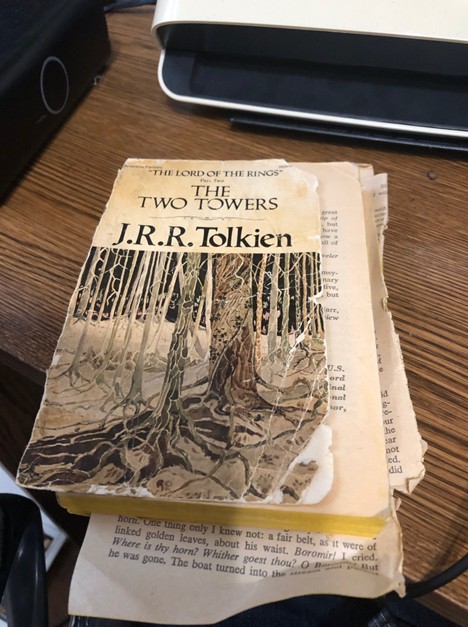
The first book I bought with my own money (you can read about how I earned that money here: A Penny A Minute) was the Lord of the Rings box set.  I have posted a picture of the Two Towers to show you how much value I got for the few dollars I spent. 

I remember buying them like yesterday at Quakerbridge Mall and using the money I earned from my first job.  I raced home, put my name on the cover in case someone tried to take it, and devoured the books like I did the Quarter Pounder that I had bought with the remaining change.

 I have now read those same books with pages falling out at least once a year.  The first time I read them all in a weekend.   I remember cowering in the bed as I read about the Black Riders for the first time and adding Frodo and Sam to my evening prayers.

Bonding with My Best Friend Over Tolkien

My best friend from elementary through middle school was Paul. He loved the Lord of the Rings as much as or more than me, and we discussed it endlessly. He also introduced me to the Lord of the Rings allusions in Led Zeppelin songs, such as Misty Mountain Hop and some Galadriel references in Stairway to Heaven. 

He also had pictures from the Lord of the Rings calendars decorating his room.  We parted ways in high school as our lives took different turns (The Road Goes Ever On!).  But I will never forget the joy I had in discussing the latest calendar and references to LOTR by Led Zeppelin!

Love of Family

My Dad was a Steelworker, a no-nonsense Blue-Collar man.  He did not care for fantasy, elves, or hobbits.  In contrast, I was like Frasier to my Dad’s Marty Crane.  

Throughout 1978, I looked for every news item on Ralph Bashki’s upcoming rendition of The Lord of the Rings. My dad got tickets for the opening day for the whole family because he knew how much I loved it. He also got me the LP soundtrack for Christmas. 

The movie was not good, but my whole family sat through it.  They sat through it and tried to cheer me up, as I was disappointed.   I never felt more loved since my family showed kindness and support for something I cared about.

My Senior High School Thesis on Tolkien

 I love to write and get as much joy from it as I do from reading LOTR. I feel exhilarated after writing each of my blogs, and unlike most, I love writing essays for school. 

My senior thesis for High School was one of my favorites – Christ Imagery in the Lord of the Rings!  I learned so much from studying this subject. 

Unlike Lewis, who is allegorical in the Narnia series, Tolkien is more subtle but profound.  Frodo, Aragorn, and Gandalf all represent elements of Christ.  Frodo is the clearest as he carries the heavy burden to Mount Doom.  Aragorn, as a disguised king, leads to a new kingdom.  Gandalf is perhaps the least subtle as he arises from the dead in white after battling the Balrog. 

Tolkien did not like allegory, but he understood the fundamental truth that our highest calling is to sacrifice.  I still remember the exhilaration of getting an A on the paper, but more so the feeling that the LOTR revealed a more profound truth!  I have learned from reading Tolkien’s Faith by Holly Ordway that Tolkien’s faith infused everything he did.

Falling for the Fellowship

I waited 23 years for the next movie version of The Lord of the Rings, The Fellowship of the Ring. My wife and I had four kids waiting for its arrival! 

My oldest daughter Kate was old enough to stay up late to catch the movie with me on the first day. It came out the day before I had to lead an Oral presentation for the biggest deal in my career. Nevertheless, I got the only two last tickets available for the midnight showing on the first day. 

My daughter and I waited anxiously in the last two seats behind a bar that partially obstructed my view.  I was praying that it would not be like the earlier movie.  I will not lie to you.  When the Shire and Gandalf scene came on the screen, I wept tears of joy. 

Peter Jackson had captured the essence of the books that defined my life: the decency of the Hobbits, the goodness of Gandalf, and the evil of the Dark Riders, which used to shake me in my bed so many years ago. 

This will sound like the ultimate geek, but I count that first viewing of the Fellowship as one of the top 10 moments in my life. (By the way, it inspired me to win the most important job of my career the next day!).

Dancing in the Glade

I thought nothing would match the scene of the Shire, but a scene from the Tolkien movie did it.  My favorite story from Tolkien is not LOTR but one chapter from the Silmarillion – Of “Beren and Luthien.”  I love it for three reasons. 

It examines the love between people of two cultures (Elves and Man). Beren and Luthien fight against all odds to defeat evil. Last and most important, it shows the never-ending love between a man and his wife. 

For the uninitiated, Beren and Luthien Tinuviel represent J.R.R. Tolkien and his wife Edith.  They were married for over 50 years.  Edith was Tolkien’s muse and the anchor to his life.  The image took my breath away as I sat beside my wife of 38+ years and thought of her in that glade.   In the movie, they show Edith dancing in the woods in England, the image Tolkien explains in his poem below. 

“The leaves were long, the grass was green,
The hemlock-umbels tall and fair,
And in the glade, a light was seen.
Of stars in shadow shimmering.
Tinuviel was dancing there.
To the music of a pipe unseen,
And the light of stars was in her hair,
And in her raiment glimmering.” (Read more here – https://www.goodreads.com/quotes/tag/luthien).

Faith Lessons from Tolkien and St John Henry Newman

 I knew Tolkien was a Catholic like me, but I realized further connections after reading Tolkien’s Faith.  Tolkien’s mother took JRR and his brother Hillary to England.  After her husband’s passing, his mother became Catholic in the Birmingham Oratory, where St. John Henry Newman resided.  More than that, Father Francis Morgan, an aide of the Saint, was JRR Tolkien’s guardian when his mother passed.

This connection deeply moved me since the prayers and writings of St. John Henry Newman have been crucial to my faith formation.  I discovered his prayers on a pilgrimage when we said one of his prayers each night during our return on our bus.   

Written Words of a Loving Father.

I am now reading The Letters of JRR Tolkien, which contains 500 pages of Tolkien’s letters. The letters give insight into his books, college life, relationship with Inklings, and, most importantly, family.  

Professor Tolkien’s most touching and instructive letters were to his son Christopher during WW II. To keep Cristopher’s spirits up, he shared his WW I experience.  He also discussed the Lord of the Rings and had Christopher edit and develop maps for the book.  He also wrote letters before WW I to his wife.  His final letter before his passing was to his daughter Priscilla about his arrival at a friend’s house.  In all, we see how Tolkien loved and instructed his family.

Eight events that shaped a life!  Thank you, J.R.R. Tolkien and the makers of this film, for making this film that explains the life of this man who shaped me and so many others!

Unfettered Wings

There was rain in the forecast for Duluth,
the day after our glorious trek along the North Shore,
spying Lake Superior from a hill near Gooseberry Falls,
seabirds floating over the inland sea.

We decided to find an indoor attraction,
longing for rain, we still did not want to get wet,
since so much time had passed,
and we feared being soaked so far from home.

The aquarium was just this side of the Aerial Bridge,
where barges from around the world,
floated unrestricted into their temporary home.

The fish and aquatic life in the tanks mirrored those,
swimming freely in the depths of the Greatest Lake,
Lake Trout, Walleye, and Sturgeon, some that lived over 100 years.

We had finished the first floor and were moving to the second,
when something curious caught our eye.
There, in the gift shop,
was a solitary, plush Eagle.

My wife said, “Oh cute. Can we get it?”
But I thought, Eagles are majestic birds of prey,
Not to be sold as toys.
Eagles must fly!

We proceeded to the second floor
until, at the last corner,
a lone Eagle with a heavy beak and piercing eyes.

It perched on a miserable little limb,
staring wantonly through a screen at the wooded hills outside.
It never turned toward us but only looked dejectedly at its former home,
where we had roamed just the day before.

Eagles are meant to fly, to soar up toward the sun!
To carry us to freedom and spread the word.
What would St. John or Moses say
to see nature’s herald trapped behind such a paltry barrier?

You can’t put God in a box, nor an Eagle behind a screen.
Eagles are meant to fly!

Eagles are not meant to be behind a screen